Event submissions
EventsThe 3rd International Electronic Conference on Foods: Food, Microbiome, and Health - A Celebration of the 10th Anniversary of Foods' Impact on Our Wellbeing
Published

This submission belongs to the session 3. Food Analytical Methods and Components of the event The 3rd International Electronic Conference on Foods: Food, Microbiome, and Health - A Celebration of the 10th Anniversary of Foods' Impact on Our Wellbeing
Published date
30 Sep, 2022
Academic Editor
'%3e%3cpath%20d='M12.6657%2010.9104C12.4185%2010.325%2012.0599%209.79327%2011.6097%209.34482C11.1609%208.89508%2010.6293%208.5365%2010.0442%208.28888C10.0389%208.28626%2010.0337%208.28495%2010.0285%208.28233C10.8446%207.69279%2011.3752%206.73249%2011.3752%205.64904C11.3752%203.8542%209.92103%202.39999%208.1262%202.39999C6.33136%202.39999%204.87715%203.8542%204.87715%205.64904C4.87715%206.73249%205.40774%207.69279%206.22393%208.28364C6.21869%208.28626%206.21345%208.28757%206.20821%208.29019C5.62129%208.5378%205.09463%208.89284%204.64265%209.34613C4.1929%209.79493%203.83432%2010.3266%203.58671%2010.9117C3.34345%2011.4845%203.21226%2012.0987%203.20023%2012.7209C3.19988%2012.7349%203.20233%2012.7488%203.20744%2012.7619C3.21255%2012.7749%203.22022%2012.7867%203.22998%2012.7968C3.23975%2012.8068%203.25142%2012.8147%203.26431%2012.8202C3.2772%2012.8256%203.29105%2012.8284%203.30504%2012.8284H4.09109C4.14874%2012.8284%204.19459%2012.7825%204.1959%2012.7262C4.2221%2011.7148%204.62823%2010.7676%205.34617%2010.0497C6.08899%209.30683%207.0755%208.89808%208.1262%208.89808C9.17689%208.89808%2010.1634%209.30683%2010.9062%2010.0497C11.6242%2010.7676%2012.0303%2011.7148%2012.0565%2012.7262C12.0578%2012.7838%2012.1037%2012.8284%2012.1613%2012.8284H12.9474C12.9613%2012.8284%2012.9752%2012.8256%2012.9881%2012.8202C13.001%2012.8147%2013.0126%2012.8068%2013.0224%2012.7968C13.0322%2012.7867%2013.0398%2012.7749%2013.0449%2012.7619C13.0501%2012.7488%2013.0525%2012.7349%2013.0522%2012.7209C13.0391%2012.0947%2012.9094%2011.4855%2012.6657%2010.9104ZM8.1262%207.9024C7.52486%207.9024%206.9589%207.6679%206.53312%207.24211C6.10733%206.81633%205.87283%206.25037%205.87283%205.64904C5.87283%205.0477%206.10733%204.48174%206.53312%204.05596C6.9589%203.63018%207.52486%203.39567%208.1262%203.39567C8.72753%203.39567%209.29349%203.63018%209.71927%204.05596C10.1451%204.48174%2010.3796%205.0477%2010.3796%205.64904C10.3796%206.25037%2010.1451%206.81633%209.71927%207.24211C9.29349%207.6679%208.72753%207.9024%208.1262%207.9024Z'%20fill='%235D1EE1'/%3e%3c/g%3e%3c/svg%3e) Arun Bhunia
Arun BhuniaCitation
Micaela Escobal, Analia Rodríguez, Luis Panizzolo, Cristina Olivaro, Fernando Ferreira, Study of melanoidins of the Maillard reaction in Dulce de Leche, in Proceedings of The 3rd International Electronic Conference on Foods: Food, Microbiome, and Health - A Celebration of the 10th Anniversary of Foods' Impact on Our Wellbeing, 1 October–15 October 2022, MDPI: Basel, Switzerland, doi: 10.3390/Foods2022-12988
Share
Email
Facebook
Twitter
LinkedIn
Study of melanoidins of the Maillard reaction in Dulce de Leche
'%3e%3cpath%20d='M12.6647%2010.9104C12.4176%2010.325%2012.0589%209.7933%2011.6088%209.34485C11.16%208.89511%2010.6283%208.53653%2010.0432%208.28891C10.038%208.28629%2010.0327%208.28498%2010.0275%208.28236C10.8437%207.69282%2011.3743%206.73252%2011.3743%205.64907C11.3743%203.85423%209.92005%202.40002%208.12522%202.40002C6.33038%202.40002%204.87618%203.85423%204.87618%205.64907C4.87618%206.73252%205.40677%207.69282%206.22296%208.28367C6.21772%208.28629%206.21248%208.2876%206.20724%208.29022C5.62031%208.53783%205.09365%208.89287%204.64167%209.34616C4.19192%209.79496%203.83334%2010.3266%203.58573%2010.9117C3.34247%2011.4846%203.21128%2012.0987%203.19925%2012.721C3.1989%2012.735%203.20135%2012.7489%203.20646%2012.7619C3.21157%2012.7749%203.21924%2012.7868%203.22901%2012.7968C3.23877%2012.8068%203.25045%2012.8148%203.26334%2012.8202C3.27623%2012.8256%203.29007%2012.8284%203.30406%2012.8284H4.09012C4.14776%2012.8284%204.19362%2012.7825%204.19493%2012.7262C4.22113%2011.7148%204.62726%2010.7676%205.34519%2010.0497C6.08802%209.30686%207.07452%208.89811%208.12522%208.89811C9.17592%208.89811%2010.1624%209.30686%2010.9052%2010.0497C11.6232%2010.7676%2012.0293%2011.7148%2012.0555%2012.7262C12.0568%2012.7839%2012.1027%2012.8284%2012.1603%2012.8284H12.9464C12.9604%2012.8284%2012.9742%2012.8256%2012.9871%2012.8202C13%2012.8148%2013.0117%2012.8068%2013.0214%2012.7968C13.0312%2012.7868%2013.0389%2012.7749%2013.044%2012.7619C13.0491%2012.7489%2013.0515%2012.735%2013.0512%2012.721C13.0381%2012.0947%2012.9084%2011.4856%2012.6647%2010.9104ZM8.12522%207.90243C7.52388%207.90243%206.95792%207.66793%206.53214%207.24215C6.10636%206.81636%205.87185%206.2504%205.87185%205.64907C5.87185%205.04773%206.10636%204.48177%206.53214%204.05599C6.95792%203.63021%207.52388%203.3957%208.12522%203.3957C8.72655%203.3957%209.29252%203.63021%209.7183%204.05599C10.1441%204.48177%2010.3786%205.04773%2010.3786%205.64907C10.3786%206.2504%2010.1441%206.81636%209.7183%207.24215C9.29252%207.66793%208.72655%207.90243%208.12522%207.90243Z'%20fill='%235D1EE1'/%3e%3c/g%3e%3c/svg%3e)
Micaela Escobal 1
Analia Rodríguez 2
Luis Panizzolo 2
Cristina Olivaro 1
Fernando Ferreira 1
1. Espacio de Ciencia y Tecnología Química, Cenur Noreste, Sede Tacuarembó, UdelaR, Tacuarembó, Uruguay
2. Departamento de Ciencia y Tecnología de Alimentos, Facultad de Química, UdelaR, Montevideo, Uruguay
Abstract
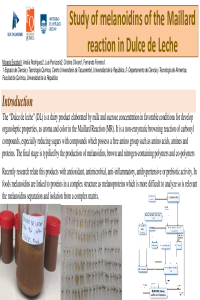
The “Dulce de leche” (DL) is a dairy product elaborated by milk and sucrose concentrated in favorable conditions for the Maillard Reaction (MR). In this reaction organoleptic properties, as aroma and color are developed. It is a type of non-enzymatic browning which involves the reaction of carbonyl compounds, especially reducing sugars with compounds which possess a free amino group such as amino acids, amines and proteins.
The final stage of the chemical reaction is typified by the production of brown and nitrogen-containing polymers and co-polymers, the melanoidins. Recently research relate this products with antioxidant, antimicrobial, anti-inflammatory, antihypertensive or prebiotic activity.
In foods melanoidins are linked to proteins in a complex structure as melanoproteins which is more difficult to analyze so it is relevant the melanoidins separation and isolation from a complex matrix.
In this study, DL was elaborated in the laboratory with skim milk and sucrose, with initiated pH 7,6. Firstly, separate with dialysis and centrifugation to obtain melanoproteins. Moreover, the insoluble and colored fraction was digested by pronase enzyme. Nextly, the digested enzymatic product was fractionated by gel filtration (BioGel P2 1 a 1,8kDa). Finally, the melanoidins were separated by solid phase extraction (SPE) using a C18 cartridge with different mixtures of methanol and water. The fractions obtained were monitored by TLC and analyzed by mass spectrometry (LC-ESI-IT-MS2).
The TLC reveal with orcinol and ninhydrin, using phenylalanine, alanine and glucose as standards, indicate the presence of carbohydrates and amino acids. In addition, some compounds were fluorescent (detection at 365 nm), in agreement with reported compounds obtained in models of the MR. Mass spectrometry analysis shows compounds with typical structural motifs of melanoidins in a complex mixture with m/z less than 1200.
Keywords
melanoidins
Maillard Reaction
Dulce de Leche
Manuscript
sciforum_063747_original_Study_of_melanoidins_of_the_Maillard_reaction_in_Dulce_de_Leche-done.pdf
Poster
congreso Foods 2022 presentation Micaela Escobal.pdf
Optimization of pigments extraction from quinoa flour fermented by Monascus purpureus supplemented with fish hydrolysate and sodium chloride
Characterization of spray dried co-microcapsules containing probiotic culture Lactococcus lactis SKL 13 and γ-aminobutyric acid (GABA) entrapped in a ternary wall matrix